On this page
Most brands can now find their AI visibility gaps. Far fewer have a reliable way to close them. A dashboard full of red is only useful if it feeds a workflow - from gap, to priority, to a published page that earns the citation. Here’s a repeatable loop that connects the two.
Start with prioritized gaps, not a wall of data
The trap after your first audit is trying to fix everything. Don’t. A gap on a low-intent definitional prompt matters far less than a gap on “best X for Y.” So the first step is triage:
- Rank gaps by buying intent - best-of and comparison prompts first.
- Weight by how many engines you’re losing - a gap across five engines is worth more than one on a single surface.
- Note who’s winning it and why - the competitor’s source is a clue to what you’ll need.
This turns a long list into a short, ordered set of the fixes that will move share of voice the most. Visibility AI’s Optimize view does this ranking for you, so you’re always working the highest-impact gap next.
Turn each gap into a specific recommendation
A gap is a symptom; a recommendation is the prescription. For each prioritized gap, the useful output isn’t “you’re missing here” - it’s “write a comparison page answering this question, structured this way, covering these points the AI is looking for.”
Visibility AI generates AI-written recommendations tied to each gap: the specific page or improvement that would make the AI more likely to cite you, grounded in what’s actually winning the answer today. That closes the distance between knowing you have a problem and knowing what to do about it.
Draft the content that engines want to cite
Recommendations still have to become real pages, and that’s where most workflows stall. The Content Agent takes a recommendation and drafts the AI-optimized content to fill the gap - structured to answer the target question directly, written to be quotable, and aligned with the sources and phrasing engines favor.
A few principles the content should follow:
- Answer the question directly and early - engines quote clear, self-contained answers.
- Be genuinely useful and specific - thin content doesn’t earn citations.
- Structure for extraction - clear headings, comparisons and lists give engines something clean to pull.
- Corroborate - pair the page with the third-party presence the answer relies on.
You stay in the loop: review, edit and publish. The Content Agent removes the blank page, not your judgment.
Publish, then measure the loop closing
The workflow isn’t done at publish. Because answer sets shift, the final step is to re-scan the same prompt and watch the gap close - did your share of voice rise on that question, across those engines? That feedback is what makes the loop a loop instead of a one-off content push.
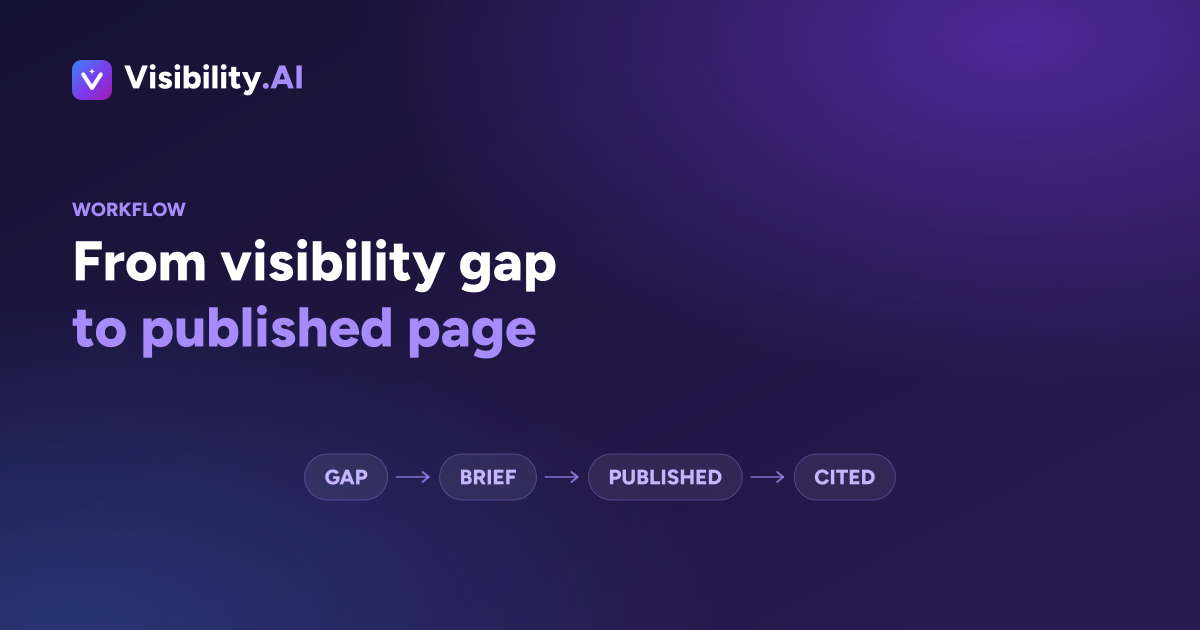
Run this end to end - prioritized gap → recommendation → drafted content → publish → re-measure - and AEO stops being a vague aspiration. It becomes a steady, provable cadence of closing your highest-intent gaps one at a time.
If you want the whole workflow in one place, Visibility AI’s free trial takes you from gap to draft in a few clicks.