On this page
- The five pillars
- Why the order matters more than the list
- Pillar 1: Be understood
- Pillar 2: Be useful
- Pillar 3: Be discoverable
- Pillar 4: Be validated
- Pillar 5: Be recommended
- Where this fits with our other framework
- What this framework will not do for you
- Where to start this week
- Frequently asked questions
“How do we get into AI answers?” is the question every business is now asking, and it usually gets one of two unhelpful replies: a list of generic best practice, or a shrug about how nobody really knows.
Neither is true. Nobody controls what an engine says, but the conditions that make a brand eligible to be named by ChatGPT, Google AI Overviews, Gemini or Perplexity are well understood and mostly ordinary. This is the framework we use, in the order that matters.
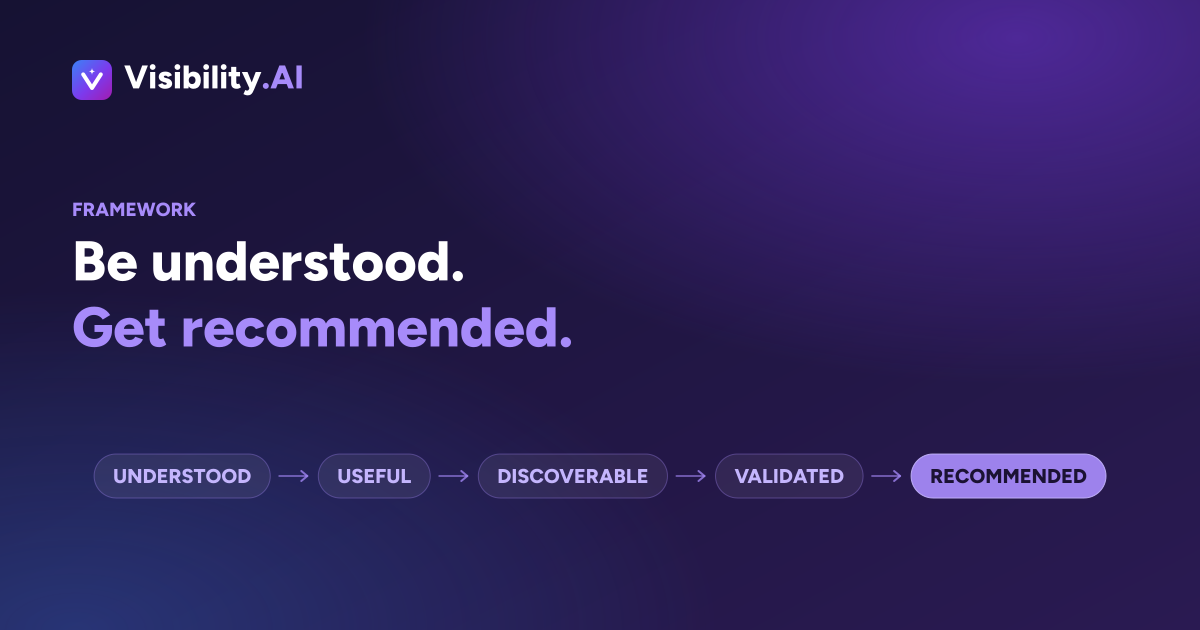
- Five pillars: be understood, be useful, be discoverable, be validated, be recommended.
- The first four are inputs you control. The fifth is the outcome they produce, which is why nobody can sell it to you.
- They are sequential dependencies, not a menu. Effort spent on a later pillar is wasted while an earlier one is broken.
- Most businesses jump straight to pillar two, publishing content, because it feels productive. The common failures are pillars one and four.
- Being understood is the cheapest pillar to fix and the one most often quietly broken.
Be understood, then useful, then discoverable, then validated. Be recommended is what happens next.
The five pillars
To get included in answers from ChatGPT, Google AI Overviews, Gemini and Perplexity, five things have to be true. In plain terms:
| # | Pillar | In plain terms | What it looks like when broken |
|---|---|---|---|
| 1 | Be understood | Keep your Google Business Profile, website, social profiles, directories and contact details accurate and consistent | Described from a stale source, wrong category, wrong city |
| 2 | Be useful | Publish pages that directly answer what customers ask, and show real, demonstrated expertise | Pages about you, not about their problem |
| 3 | Be discoverable | Make pages fast, crawlable, mobile-friendly and well structured | Blocked crawlers, JS-only content, buried answers |
| 4 | Be validated | Earn reputable mentions beyond your own site: local media, associations, partners, reviews, podcasts | Absent from the handful of sites the answers draw on |
| 5 | Be recommended | Track whether you are named for the prompts that matter, and close the gaps | Competitors named in your place |
Why the order matters more than the list
Most frameworks in this space are a menu of tactics. This one is a dependency chain, and that is the whole point of it.
Content cannot rescue a brand the engine does not understand. If the web describes you as an enterprise vendor and you sell to small teams, a beautifully written comparison page gets read through that lens or not retrieved at all. Citations cannot rescue a site the crawler cannot fetch. And nothing rescues pillar five, because pillar five is not a task.
This explains the most common pattern we see. A business asks how to get into AI answers, is told to publish content, spends a quarter doing it, and nothing moves. The content was usually fine. It was the second pillar, being poured onto a broken first and fourth.
So work top down, and check each pillar before spending on the next.
Pillar 1: Be understood
The engine assembles a picture of your business from everything it can find, then answers from that picture. If the sources disagree, you are a blurry entity, and blurry entities get left out of confident answers.
What to make identical everywhere it appears, including your site, Google Business Profile, LinkedIn, directories, review platforms and press coverage:
- Name. One form, including punctuation and any legal suffix.
- Category. What you would call yourself, in the words a buyer would use.
- Location and service area. Especially where you serve a region but list one address.
- What you actually do. The most common failure. Old positioning survives online long after you have moved on.
Schema markup belongs here too. It makes your identity, offerings and location machine-readable, which removes ambiguity. It is groundwork rather than a lever: a perfectly marked-up page nobody cites still loses to a cited one.
Reviews sit here as well as under validation. Genuine reviews, and visible replies to them, are one of the strongest signals that a business is real, active and described accurately. They are also read by engines as evidence of what you are good at, which means the wording customers use about you becomes part of how you are described.
This pillar is the cheapest to fix and the most often quietly broken, which makes it the best place to start. Nothing else you do pays off properly until it is right.
Pillar 2: Be useful
Engines answer questions. Pages that answer the same questions are the raw material.
The shift is away from pages about your company and toward pages about the buyer’s problem. In practice that means pages covering your services, the factors that drive pricing, the locations you serve, how your process works, frequently asked questions, comparisons against the alternatives, and “best for” use cases that say plainly who you suit. A page titled “our services” answers nothing a buyer asked.
Demonstrated expertise is part of this pillar, not a separate one. Engines weigh evidence that you have actually done the work, and the way to supply it is in the content itself: case studies, project photos, credentials and licences, named team expertise, original data you collected, real product specifications, and clear author and company information on the page. Two pages can make the same claim, and the one carrying evidence is the one worth citing.
Two practical rules matter more than volume:
Answer in the first hundred words. Engines lift passages. If your page’s own question is answered in paragraph six, it is harder to extract than a competitor’s page that answers it immediately and then elaborates.
Cover the unflattering questions. Price, alternatives, downsides, “is X worth it”. These get asked constantly and most companies refuse to answer them, which leaves the answer to be assembled from someone else’s page.
There is decent evidence that this work moves the needle. A Princeton-led study tested optimization methods across roughly 10,000 queries and found visibility gains of 22 to 41 percent depending on method, with adding statistics to a page worth about 41 percent on its own. Notably the gains went overwhelmingly to pages not already ranking first, which improved by around 115 percent, while first-place pages barely moved. If you are the incumbent, this pillar is not where your leverage is.
Pillar 3: Be discoverable
The plumbing. Before an engine can cite you it has to fetch and understand you.
Crawler access. Check your live robots.txt for the AI crawlers by name, not just Googlebot. Two groups are worth separating: crawlers that fetch a page live while someone waits for an answer, and crawlers that read pages into a model for training. Blocking the second is a legitimate business decision. Blocking the first removes you from answers. Check the file on the live host, because blocks added at a CDN never appear in the version you deployed.
Rendering. If your content only exists after JavaScript runs, assume some engines will not see it. View the raw HTML response and confirm the substance is in it.
Structure and performance. Sensible headings, working schema, visible dates, no orphan pages, pages that load fast, and a site that works properly on a phone. None of this is exotic and all of it is checkable in an afternoon.
None of this wins you an answer. All of it can lose you one, silently, for months.
Pillar 4: Be validated
Engines are more likely to name a business that other credible sources already mention. This is where most of the real gap sits, and where the standard advice is worst.
The standard advice is to buy a lot of directory listings. Our own citation corpus says that is mostly wasted money. Looking at 43,161 citations across 4,710 AI answers spanning 41 brands, a typical hundred-row industry directory checklist accounted for 25.1% of citations, and google.com alone was 19.2% of that. Fifty-four of the hundred had never been cited once. The remaining ninety-eight shared 3.7% between them.
Across four verticals we compared the top cited platforms and exactly one, Google, appeared in all four. Everything else was specific to the industry. So the useful version of this pillar is not “get listed everywhere”. It is:
Find the few sources that actually get cited in your category, and be on those. Take the answers where a competitor was named instead of you, record every source cited, and tally the domains. That list is short, specific to you, and finite. Running an AI visibility audit covers the full method.
The sources worth pursuing are broader than directories, and the good ones are usually local or industry-specific rather than famous: local media and news coverage, industry directories, trade associations and professional bodies you already belong to, partners and suppliers who list their customers, customer review platforms, podcasts and interviews, and publications that cover your sector. Membership you already pay for is the cheapest of these, because the listing exists and often just needs claiming.
Fixing a wrong listing usually beats creating a new one, too: the page already exists and has a claim or suggest-an-edit flow.
One honest caveat. In one vertical we looked at, the top cited sources after Google were competitor websites rather than directories at all. For those brands, listings are the wrong advice and comparison content is the right one. The correct fix genuinely differs by category, which is why generic recommendations fail.
Pillar 5: Be recommended
The fifth pillar is different in kind from the other four, and pretending otherwise is where this industry loses credibility.
You cannot do “be recommended”. It is not a task, it has no checklist, and there is no placement to buy inside an organic AI answer. It is the outcome of the first four, decided by a system nobody outside the engine controls.
What you can do is measure it, which is what turns the other four pillars from faith into work.
Pick the prompts that actually matter to your business, the questions a buyer types before they know who you are, and fix that list so it does not move between readings. Then track them across ChatGPT, Google AI Overviews, Gemini, Perplexity and the rest, recording four things each time: whether you were named, where you ranked, how you were described, and which sources the answer cited. Watch the series move, and feed what it shows back into the earlier pillars. A prompt where you are never named is a content gap or a source gap, and the citations tell you which.
Without that loop you cannot tell a successful quarter from a wasted one.
Treat any vendor promising guaranteed AI recommendations as disqualified. They are selling pillar five, and pillar five is not for sale.
The right work, in the wrong order. A services business publishes twelve articles over a quarter and sees no movement in AI answers. The audit finds two things: the web describes it under an old service category it dropped years ago, and the answers it loses cite two directories it has no listing on. The content was competent. It was pillar two, built on a broken pillar one and four.
Where this fits with our other framework
We describe the product as a loop: monitor, diagnose, optimize, prove. That is the process you run. The five pillars are the substance the process acts on.
| The loop | The pillars | |
|---|---|---|
| Answers | How do I work on this? | What has to be true? |
| Shape | Repeating cycle | Sequential dependencies |
| Used for | Running the programme | Deciding what to fix first |
Monitoring tells you pillar five is failing. Diagnosis tells you which of pillars one to four caused it. The two fit together, and neither replaces the other.
What this framework will not do for you
It will not tell you which pillar is broken. The framework is the map. Finding your position on it is a separate exercise, and guessing is the expensive way to do it.
It does not weight the pillars for your category. Being validated dominates for local and service businesses. Being useful dominates where competitor sites are the cited sources. The order of operations holds; the effort split does not.
It cannot promise a timeline. Entity and technical fixes can register within weeks. Earning citations from new sources usually takes a quarter, because it depends on other people publishing.
It will not survive without measurement. Four pillars of work and no fixed prompt set to measure against leaves you with opinions.
Where to start this week
If you do nothing else, do this in order.
Search your own brand name across Google, your Google Business Profile, LinkedIn and the two biggest directories in your industry. Write down every description of your business you find. If they disagree, pillar one is your problem and it is the cheapest one to fix.
Ask three buying questions a customer would type into ChatGPT, Perplexity and Google’s AI results, and record every source cited in the answers where a competitor was named instead of you. Tally the domains. That is pillar four, and the list will be shorter than you expect.
Check your live robots.txt for AI crawlers by name. Two minutes, and it occasionally explains everything.
Then pick the earliest broken pillar and fix that one, rather than the one that feels most productive. You can run our free Visibility Check for the fast version of the second step, or work through the full audit framework by hand. Either beats publishing another twelve articles and hoping.
Frequently asked questions
How do I get my business to show up in AI answers?
Satisfy five conditions in order: be understood as a clear entity, be useful with content that answers real buyer questions, be discoverable so engines can fetch and parse your pages, be validated by sources engines already cite, and only then be recommended. Skipping straight to publishing content is the most common mistake.
What are the five pillars of AI visibility?
Be understood, be useful, be discoverable, be validated, be recommended. The first four are inputs you control directly. The fifth is the outcome they produce, which is why no tool or agency can promise it. They are sequential: work spent on a later pillar is wasted while an earlier one is broken.
How long does it take to appear in AI answers?
Entity and technical fixes can register within days to a few weeks, because engines refetch pages and reread listings regularly. Earning citations from new sources is slower, usually a quarter, because it depends on other sites publishing and engines picking those up. Expect movement in weeks, not days.
Do I need more content to get into AI answers?
Often less than you think. In our own citation data the gap for most local and service brands is a small number of sources they are missing from, not a shortage of pages. Content is the right lever when the sources engines cite in your category are competitor websites rather than directories, which does happen.
Can I pay to be recommended by AI engines?
No. There is no placement to buy inside an organic AI answer, and nobody controls what an engine outputs. You change the inputs the engine reads and it still decides. Any vendor promising guaranteed AI recommendations is selling something they cannot deliver, and that promise should end the conversation.
Why does AI mention my competitors and not me?
Usually because the sources those answers draw on include them and not you. Check the citations under the answers you lose and tally the domains. If the same few sites appear repeatedly and you have no presence on them, that is the mechanism, and it is a more useful finding than any score.
Does schema markup help you appear in AI answers?
It helps with being understood and discoverable rather than being recommended. Schema makes your identity, offerings and location machine-readable, which reduces ambiguity. It is necessary groundwork and it is not a lever on its own. A perfectly marked-up page nobody cites still loses to a cited one.
Is getting into AI answers different from SEO?
The work overlaps but the target differs. SEO earns a ranking position on a results page. AI visibility earns a mention inside a generated answer, which is assembled from sources the engine retrieved. You can rank first and still be absent from the answer, because ranking and being cited are different mechanisms.