On this page
- Start from a baseline, not a checklist
- Find the constraint that is actually costing you
- You are not resolvable
- You are not present in the sources being cited
- You are present but not preferred
- Fix in leverage order
- 1. Make yourself unambiguous
- 2. Get onto the sources that already supply the answers
- 3. Publish content that answers the actual question
- What does not move the number
- Re-measure honestly
- The realistic shape of this
- Frequently asked questions
Most advice on improving visibility in AI search engines is a checklist: add schema, write FAQs, get mentioned on more sites, keep your listings consistent. None of it is wrong. All of it is useless without one thing first, which is knowing which item on that list is the one actually costing you answers.
A checklist assumes every brand is failing in the same way. They are not. Two businesses in the same category can have identical visibility scores for completely different reasons, and the fix for one does nothing for the other. This is a playbook for working out which situation you are in, and what to do about it in the order that produces movement.
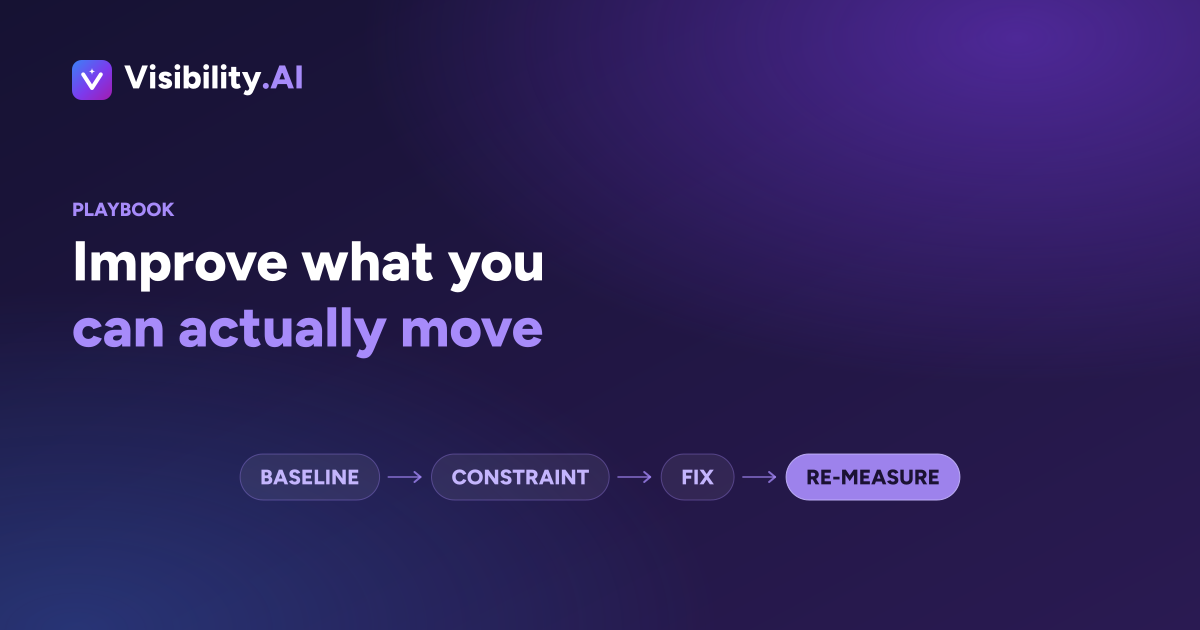
- Improvement starts from a measured baseline, not a checklist. Without one you cannot tell which work is wasted.
- There are three common constraints, and they have different fixes: you are not resolvable, you are not present in the cited sources, or you are present but not preferred.
- Fix in leverage order. Entity clarity is cheapest and most often quietly broken. Sources are slowest and usually the real gap.
- More content is the most common first move and frequently the wrong one.
- Re-measure against a fixed prompt set. Changing the prompts between runs destroys the comparison.
Start from a baseline, not a checklist
You cannot improve a number you have not measured, and the number matters less than its composition.
A useful baseline answers three questions. How often are you named across a fixed set of prompts and engines. Which sources do those answers cite. And when you are absent, who is named instead. The first is the headline. The second and third are what tell you what to do.
The reason the composition matters more than the score: a brand named in two of twenty answers has a very different problem depending on whether the eighteen losses cite a directory it is missing from, or cite its own competitors’ websites, or cite nothing recognisable at all. Same score, three different projects.
Fix the prompt set before you start. Whatever prompts you choose become the yardstick for every future comparison, so they need to stay still. A list that grows or shifts between runs will show movement that is really just a change in what you asked. This is the single most common way businesses fool themselves about progress.
Find the constraint that is actually costing you
Three constraints account for most of what we see. They present similarly in a score and are easy to tell apart once you read the citations.
You are not resolvable
The engine cannot confidently work out who you are. Your name is ambiguous, or your details differ between your site, your Google listing, and the directories that describe you, or nothing on your site states plainly what you do and where.
How to tell: ask an engine directly about your business by name and location. If it hedges, describes a different company, mixes up two locations, or gets your category wrong, you have an identity problem. This is also worth checking even when the answer looks fine, because engines will confidently produce a fluent wrong answer.
This is the cheapest constraint to fix and the one most often quietly broken, particularly for businesses that have moved, rebranded, merged, or opened a second location.
You are not present in the sources being cited
The engine knows who you are, but the material it draws on when answering your category’s questions does not mention you.
How to tell: collect the citations under the answers you lose and tally the domains. A clear pattern usually appears fast. If the same six or seven sites keep supplying those answers and you appear on none of them, that is your constraint, and it is a finite task list rather than an open-ended content programme.
In our own citation data, this is the gap for most local and service brands: a small number of sources they are missing from, not a shortage of pages on their own site.
You are present but not preferred
You do get cited, and a competitor gets named more often or more favourably.
How to tell: you appear in citations but not in the answer text, or you are listed last, or you are mentioned with a qualifier while a competitor gets a recommendation. This is the hardest constraint and the one where content genuinely is the lever, because what is being compared is the substance of what those sources say about you.
Fix in leverage order
The order below is not arbitrary. Each step makes the next one work better, and work spent out of order tends to evaporate.
1. Make yourself unambiguous
Cheap, fast, and the foundation for everything else.
Get your name, address, phone number, category and hours identical everywhere they appear: your site, your Google Business Profile, and the major directories in your category. Not similar. Identical. “Suite 500” in one place and “Ste 500” in another is the sort of difference that costs an engine confidence.
State plainly on your own site what you do, who for, and where. A surprising number of sites never say it in a sentence a machine can extract, because the copy is written to sound impressive rather than to be understood.
Add structured data for your organisation, location and services. Schema will not get you recommended, and treating it as a growth lever is a mistake. What it does is remove ambiguity, which is a precondition for everything after it.
Expect movement in: days to a few weeks. Engines refetch pages and reread listings on their own schedule.
2. Get onto the sources that already supply the answers
Usually the real gap, and usually the slowest work.
You already have the target list from your baseline: the domains that keep appearing in the answers you lose. Work them in order of how often they appear. For most local and service categories these are directories, category roundups, review platforms, and a handful of trade publications. For software they skew toward comparison sites, forums and Reddit threads.
Three things worth knowing here. First, claiming an existing listing is faster and easier than creating a new one, and many businesses already have unclaimed listings sitting on these sites. Second, being present is not enough on its own, because a thin listing gives an engine nothing quotable to pull. Third, a genuinely useful contribution to a discussion in your category can end up cited, which is why forums and community threads keep appearing in citations for software and service categories.
Expect movement in: a quarter, roughly. This depends on other sites publishing and engines picking that up, neither of which you control.
3. Publish content that answers the actual question
Third, not first, and only against gaps you have identified.
The content that gets pulled into AI answers tends to share a shape: it addresses a specific question directly, it puts the answer near the top rather than after eight hundred words of preamble, it is concrete enough to be quoted, and it is attributable to someone with a reason to know. Comparison pages, straightforward how-to explanations, and honest pricing pages are disproportionately represented, because they answer questions people actually type.
Write against the prompts you are losing, not against a keyword list. The prompt is the question. If you are absent from answers about “best X in Y city”, the useful page is the one that genuinely helps someone choosing an X in that city, not a page optimised for that string.
Expect movement in: weeks to a couple of months, and only where content was the constraint.
What does not move the number
Worth naming, because these consume real budget.
Publishing volume for its own sake. Twenty thin pages will not outperform being cited by two sources engines already trust. If your constraint is sources, content is displacement activity.
Keyword density and other ranking-era habits. Answers are assembled from retrieved passages, not scored on term frequency. Writing for extraction beats writing for density.
Chasing every engine separately. The underlying work of being resolvable and being cited helps everywhere at once. Engine-specific tactics are mostly a distraction from that, though it is still worth tracking more engines than you optimise for, so you can see where the work actually lands.
Anyone selling guaranteed placement. There is no placement to buy inside an organic AI answer. You change the inputs and the engine still decides. A guarantee is a claim about something the vendor does not control, and it should end the conversation.
Re-measure honestly
Run the same prompts, on the same engines, and compare like with like. This sounds obvious and is where most measurement falls apart, because the temptation to add prompts as you learn more is strong and it quietly ruins the baseline.
Two things to watch beyond the headline number.
Which sources are cited now. If your source work is landing, new domains appear in the citation list before your mention rate moves. That is the leading indicator, and it usually shows up weeks before the score does.
Where you are named, not just how often. Moving from cited-but-not-mentioned to named in the answer text is real progress even when the percentage barely moves.
Be careful about causation. AI answers shift on their own as models update and as the web changes underneath them, so a change following your work is not proof your work caused it. Correlation over a reasonable window with a stable prompt set is the honest standard here, and anyone claiming stronger attribution is overstating what the data supports.
The realistic shape of this
For most businesses the honest sequence is: a week or two of unglamorous cleanup work on identity and consistency, a quarter of steady effort getting onto four or five specific sources, and content written against real gaps rather than a calendar. Movement shows up in the citation list first and in the headline number later.
That is slower than most vendors imply and considerably more tractable than the shrug you get from people who insist nobody knows how any of this works. The mechanism is not mysterious. Engines retrieve from sources, and being in those sources is something you can work on deliberately once you know which ones they are.
The part worth repeating: find the constraint first. The businesses that waste the most time here are the ones that skipped straight to publishing because it felt like progress, while the actual thing standing between them and the answer was a handful of directory listings and an address that did not match.
Frequently asked questions
How do I improve my brand's visibility in AI search engines?
Start from a measured baseline rather than a checklist, identify which single constraint is costing you answers, and fix that one first. The three common constraints are that engines cannot resolve who you are, that the sources they cite in your category do not mention you, or that they cite you but name a competitor more often. Each has a different fix, and work on the wrong one produces no movement.
How long does it take to improve AI visibility?
Entity and technical fixes can register in days to a few weeks, because engines refetch pages and reread listings regularly. Earning mentions on sources you are absent from usually takes a quarter, because it depends on other sites publishing and engines picking that up. If a vendor promises movement in days on the citation side, they are describing the easy half.
Why does my competitor appear in AI answers when I do not?
Almost always because the sources those answers draw from include them and not you. Read the citations under the answers you lose and tally the domains. If a handful of sites appear repeatedly and you have no presence on any of them, that is the mechanism, and it points at a specific, finite task list rather than a vague content strategy.
Does publishing more content improve AI visibility?
Only when your constraint is content. If engines cannot tell which business you are, or if the sources they cite in your category are directories and roundups you are missing from, more pages on your own site will not change the answer. Publishing is the most common first move and often the least effective one, because it feels productive.
How do I measure whether my AI visibility improved?
Track a fixed set of prompts across a fixed set of engines and compare the same grid over time. Changing the prompt list between runs makes the comparison meaningless, which is the most common measurement error. Look for a change in how often you are named and in which sources are cited, not just a single headline percentage.
Can I pay an AI engine to recommend my brand?
No. There is no placement to buy inside an organic AI answer. You change the inputs an engine reads and it still decides what to say. Any vendor offering guaranteed AI recommendations is selling something they cannot deliver.
Which AI engines should I try to improve visibility in first?
The ones your buyers actually use, which for most businesses means starting with ChatGPT and Google's AI surfaces, then Perplexity. Improvements are rarely engine-specific, because the underlying work of being resolvable and being cited helps everywhere. Track more engines than you optimise for so you can see where the work lands.
Is improving AI visibility the same as SEO?
The work overlaps and the target differs. SEO earns a position on a results page. AI visibility earns a mention inside a generated answer assembled from retrieved sources. You can rank first for a query and be absent from the answer above it, because ranking and being cited are separate mechanisms.