On this page
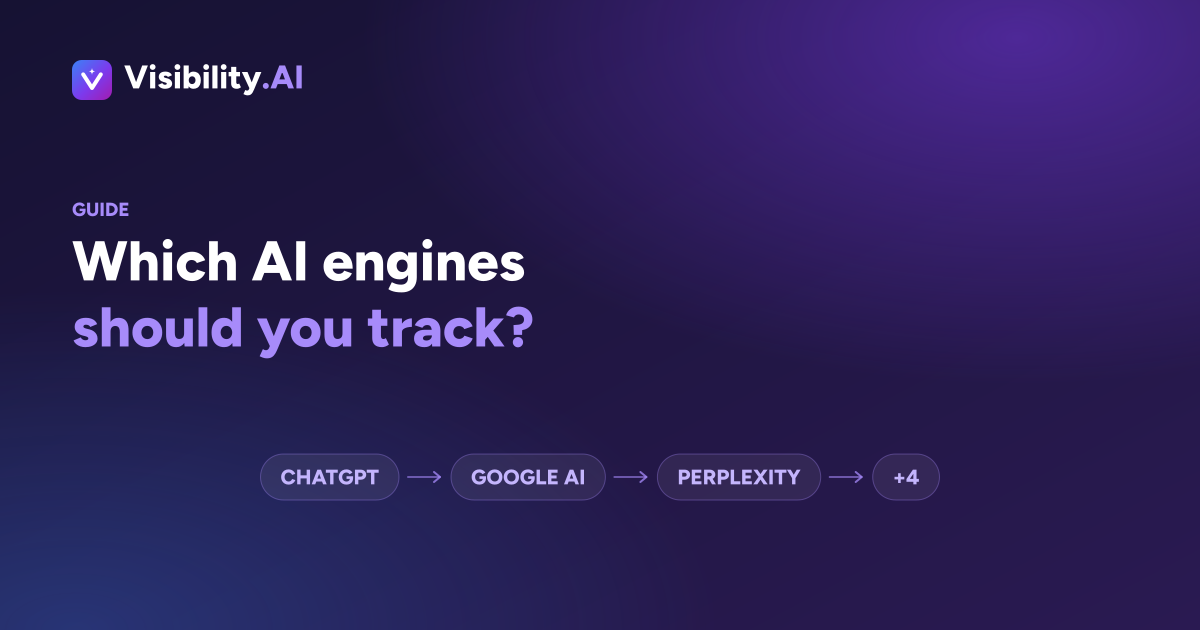
If you’re serious about answer-engine optimization, the first question is deceptively simple: which engines should I actually track? Track too few and you miss where your buyers are. Track everything blindly and you drown in noise. Here’s how to think about it in 2026.
The engines that matter
These are the answer surfaces where real buying decisions are being shaped today:
ChatGPT
The most widely used AI assistant, and for many categories the default place buyers ask “what’s the best tool for X?”. With browsing and search built in, ChatGPT increasingly cites live sources - making it a top priority for nearly every brand.
Perplexity
Purpose-built as an answer engine, Perplexity is citation-heavy and popular with researchers and higher-intent buyers. Because it surfaces its sources prominently, it’s one of the clearest signals of whether your content is trusted.
Google AI Overviews
The AI summaries now appearing at the top of Google Search reach an enormous audience. If your buyers still start on Google, AI Overviews are where the traditional search journey now begins - and often ends.
Google AI Mode
Google’s dedicated conversational search experience. As it expands, it becomes a distinct surface from classic Overviews, with its own patterns for which sources get pulled into answers.
Gemini
Google’s flagship assistant, embedded across its ecosystem. Its reach through Android, Workspace and Search integrations makes it important for consumer and productivity-adjacent categories.
Claude
Anthropic’s assistant, widely used in professional and technical contexts. For B2B, developer and knowledge-work categories, Claude is an increasingly common place decisions get researched.
Microsoft Copilot
Built into Windows, Edge, Microsoft 365 and Bing, Copilot reaches a huge base of business users right in their workflow. If your buyers live in the Microsoft ecosystem, it belongs on your list.
How to decide where to focus
You don’t need to weight every engine equally. Use these factors:
- Where your buyers already are. A developer-tools brand should weight Claude and Perplexity heavily; a consumer brand may lean toward ChatGPT and Google AI Overviews.
- Citation behavior. Engines that cite sources (Perplexity, AI Overviews) give you the clearest, most actionable feedback on what to fix.
- Your plan and scale. Start with the two or three engines closest to your buyers, prove the loop works, then expand coverage as you grow.
Track breadth, then depth
The winning approach in 2026 is to track the engines your buyers use, across the prompts that carry real intent, on a recurring schedule. A single snapshot tells you little; regular tracking shows you movement, catches competitors overtaking you, and proves your fixes are working. If you’re weighing up tools for it, start with what an AI visibility tracker should measure.
That’s the whole idea behind Visibility AI: one dashboard covering ChatGPT, Perplexity, Gemini, Google AI Overviews, Google AI Mode, Copilot and Claude, scanning your prompts on the schedule you set, so you always know where you stand - and where to act next.
Start with the engines that matter most to your buyers, measure honestly, and let the data tell you where to expand.