On this page
- The complaint is accurate
- Measurement and execution are different businesses
- The five levels of “tells you what to fix”
- The most valuable output is the citation map
- What usually needs fixing is not what people expect
- Does the fixing half actually work?
- The ceiling nobody can pass
- How to test a tool on this axis
- Where we sit, honestly
- If you are evaluating tools right now
- Frequently asked questions
A post on r/SaaS put the complaint about this category better than any of us in it would like: “Every AI visibility tool I’ve tested only does monitoring. None of them tell you what to actually fix.”
That is a fair description of the market, and it is worth explaining rather than denying. The reason almost every tool stops at a dashboard is structural, not lazy, and understanding the structure tells you what to demand instead.
- Monitoring is a read operation on public data. Fixing is a write operation against systems the tool does not own. That asymmetry is why the category clusters at dashboards.
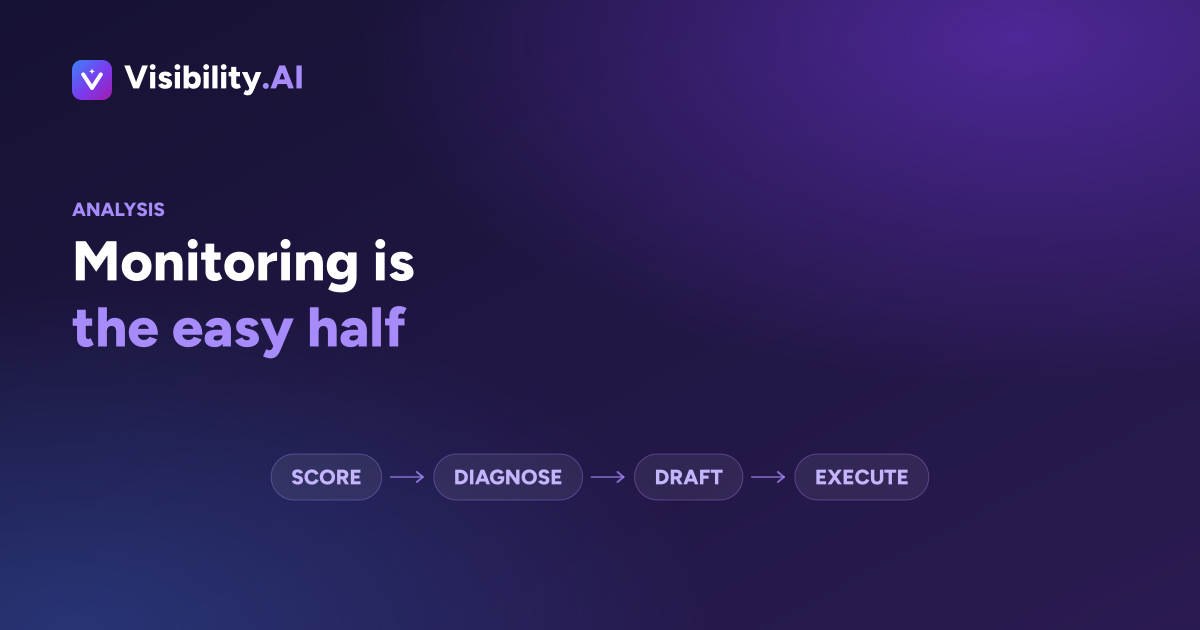
- "Tells you what to fix" spans five levels, from a score to a published change. Most tools stop at one or two and describe it as three.
- The most useful output is not a score or advice. It is the list of sources the answers you lost actually cite.
- In our own citation data the fix for most brands is a handful of missing sources, not a content programme. In some categories it is the reverse.
- Some steps genuinely cannot be automated, and a tool promising to automate them is a warning sign rather than a feature.
The complaint is accurate
Start by conceding the point, because the category has earned it.
If you buy five AI visibility tools you will get five versions of the same artefact: a percentage, a list of prompts, a set of engines, and a competitor leaderboard. Some will be better built than others. Almost all will leave you in the same position, which is knowing you have a problem and not knowing what to do on Monday.
Many ship a “recommendations” tab, and this is where the frustration in that thread really comes from. The recommendations are usually generic best practice: publish more content, add FAQ schema, improve E-E-A-T, build authority. All defensible. None of it is derived from your result. You could have written the same list before buying the tool, which means it is content, not analysis.
Measurement and execution are different businesses
Here is the structural reason, and once you see it the market makes sense.
Monitoring is a read operation. You ask engines questions and record the answers. It needs no permissions, no credentials, no access to anything of yours. It scales like an API call, the cost is predictable, and nothing can go wrong that is your fault. Two engineers can build a credible monitoring product.
Fixing is a write operation against systems the tool does not own. Your website. Your CMS. Directory listings that require account creation and phone verification. Review platforms with their own rules. Other people’s websites, which you can only ask. Each one needs an integration, a credential, an error path, and someone accountable when a publish goes wrong at 2am.
One of those is a software problem. The other is a software problem wrapped in an operations problem. They attract different companies, and the second is far less pleasant to build, which is why so few do.
You can watch the same split in the vendors that do bulk directory submission. The serious ones do not automate it. They employ people to fill in the forms, which is why that work is priced per listing and takes days rather than seconds. That is not a failure of engineering. It is what the problem actually costs.
The five levels of “tells you what to fix”
The phrase hides a wide range. This ladder is the most useful lens we know for judging a tool, and it is deliberately written so you could apply it to us.
| Level | What you get | Example | Who does this |
|---|---|---|---|
| 1. Score | A number | ”You appear in 12% of answers” | Everyone |
| 2. Diagnosis | The cause behind the number | ”The answers you lost cite three directories you are absent from” | Some |
| 3. Prescription | A specific instruction | ”Claim your listing on X; write a comparison page for Y” | Few |
| 4. Artifact | The thing itself, ready to use | The drafted page, the schema block, the outreach email | Very few |
| 5. Execution | The change is live | Published, submitted, sent | Fewer still |
Two things follow from the ladder.
The first is that level 2 is the cheapest real improvement any tool could make, and most skip it. The citation data is right there in the answers. Recording which domains appear behind the results you lost costs nothing extra and converts a score into a finding. A tool that shows you a percentage but not the sources behind it has chosen not to tell you the useful part.
The second is that the gap between 3 and 4 is where the work actually lives. “Write a comparison page targeting X” is not a fix. It is a task, handed back to you, with the hard part still ahead. Whether a tool crosses that line is the single biggest difference in whether anything changes.
The most valuable output is the citation map
If you take one practical thing from this piece, take this.
For every answer where a competitor was named and you were not, record the sources that answer cited. Tally the domains. In most categories a small number of them do most of the work, and they are the retrieval path into those answers.
That single tally reframes the problem from “we need more content” into “we are absent from four specific places”, which is a finite piece of work with a defined end. It is also the thing you can hand to someone and have them finish.
Our guide on running an AI visibility audit sets out the full four-layer version of this, and the sources AI engines trust covers which categories of source tend to carry weight.
What usually needs fixing is not what people expect
We looked at our own corpus to check whether the standard advice holds up. At the time of writing that is 43,161 citations across 4,710 AI answers, spanning 41 brands in a handful of verticals. It is an early sample, so trust the shape rather than the decimal places.
Three findings, all of which cut against how this category usually talks:
The famous directory checklists are mostly dead weight. Working from a hand-built top-100 directory plan for one brand’s industry, 54 of the 100 had never been cited once in our entire corpus. The whole 100-row plan accounted for 25.1% of citations, and google.com alone was 19.2% of that. The other 98 directories shared 3.7% between them. Buying a hundred listings sorted by domain authority is mostly buying the 3.7%.
There is no universal list. Across four verticals we compared each one’s top-cited platforms. Exactly one source, Google, appeared in all four. Everything else was specific to the vertical. Any tool recommending the same directory list to a law firm and a spa is not reading its own data.
Sometimes content really is the answer. In one vertical the top cited sources after Google were not directories at all, they were competitor websites. For those brands “get more listings” would be wrong advice, and comparison content is the honest recommendation. The right fix genuinely differs by category, which is precisely why generic recommendation tabs fail.
The score points the wrong way. A services brand appears in 2 of 45 prompt-and-engine cells and concludes it needs a content programme. The citations behind the answers it lost point at two directories it has no listing on. The first fix is two listings and a corrected category, not a quarter of blog posts. The monitoring was accurate and the conclusion drawn from it was wrong.
Does the fixing half actually work?
Worth asking, because if deliberate changes did not move AI visibility then monitoring would be the only honest product to sell.
The best public evidence is the GEO paper from a Princeton-led team, which tested optimization methods against a benchmark of roughly 10,000 queries across nine datasets. Targeted changes lifted visibility in generative answers by 22 to 41 percent depending on method, with the strongest three landing in the 30 to 40 percent range. Adding statistics to a page improved its citation visibility by about 41 percent.
The most useful finding for this argument is the one that gets quoted least. The gains were not evenly distributed: lower-ranked pages, around position five, improved by roughly 115 percent, while pages already ranking first barely moved.
Read that carefully, because it says two things at once. The fixable half is real and measurable. And the right fix depends entirely on where you already stand, which is exactly what a generic recommendations tab cannot know. The same advice that doubles visibility for an also-ran does close to nothing for a leader, and a tool handing both the same checklist is wrong for one of them.
Two caveats in keeping with the rest of this piece. The study measures visibility within generative answers under test conditions, not revenue, and the engines have changed since it was published. Treat the direction as well evidenced and the exact percentages as dated.
The ceiling nobody can pass
An honest version of this argument has to include what cannot be automated, because a tool promising otherwise is the real red flag.
Listing verification. Phone calls, postcards, email confirmations. These exist specifically to prove a human controls the business. Automating them is either impossible or a policy violation.
Community participation. Posting in forums and communities as yourself. Automating this is how communities get poisoned, and it will eventually get the brand banned rather than cited. Draft it, then let a person post it.
Anything that requires being the business. Changing a legal name, responding to a customer complaint, deciding what the company is for.
Making an engine recommend you. Nobody controls the output. You change the inputs and the engine still decides. Any promise of guaranteed AI recommendations should end the conversation.
Our own rule for this is that the steps that cannot be automated are usually the steps that should not be. The right design is to remove all the preparation work around them and leave the human decision intact.
How to test a tool on this axis
- Show me the sources cited in an answer where I lost. If it cannot, it is a level 1 tool.
- Give me a recommendation that would be false for a different company. Generic advice means it is not derived from my data.
- Where does this recommendation come from? A named finding, or a best-practice list?
- Can it produce the artifact, not just the instruction? Ask to see one.
- What does it do that is specific to my industry, and where did that come from?
- What does it refuse to automate, and does it say why? A tool with no stated limits has not thought about them.
- Can it show whether a change worked, using the same prompts measured before and after?
- Does it promise rankings or recommendations it cannot control?
The last one matters most in the other direction. A tool that overclaims on execution is worse than one that honestly stops at monitoring, because you will not find out for a quarter.
Where we sit, honestly
We built Visibility AI because of exactly this complaint, so it would be convenient to claim we solved it. The accurate version is narrower.
We do levels 1 and 2 as the core product: a fixed prompt set across seven engines, with the citations recorded per answer so the sources behind a loss are visible rather than implied. Level 3 comes from that data rather than from a best-practice list, which is the part we think is genuinely different.
For level 4 we draft the artifact: pages, schema, FAQ blocks, outreach emails, community replies. For level 5 we go live only where it is ours to do, which is publishing to a CMS you have connected. We deliberately do not auto-post to communities and we do not attempt directory verification, for the reasons above. The Reddit Agent drafts and never posts. The Backlink Agent sends from your own mailbox, not ours.
And the honest limits: we sample, like everyone, because no engine publishes brand-level answer data. Our per-vertical citation data is early. Nothing here makes an engine recommend you, it changes what the engine has to work with.
That is a real answer to the Reddit complaint rather than a rebuttal of it. The category does mostly stop at monitoring. The fix is not a better dashboard, it is treating the dashboard as the first of five steps instead of the product.
If you are evaluating tools right now
Run the citation-map exercise by hand before you buy anything. Take five prompts a buyer would type, ask them on three engines, and write down every source cited in the answers where a competitor was named instead of you. It takes under an hour and costs nothing.
Whatever tool you buy should be able to do that automatically, repeatedly, and then tell you what to do about it. If it cannot do the first part, the recommendations it gives you are not coming from your data, and you already know what generic best practice looks like.
You can run ours as a free Visibility Check, or read the full audit framework and do it by hand. Both are better than a score with nothing underneath it.
Frequently asked questions
Why do AI visibility tools only do monitoring?
Because monitoring is a read operation and fixing is a write operation. Sampling what engines say needs no permission and scales as an API call. Changing the answer means acting on systems the tool does not own: your CMS, directory listings, other people's websites. That needs integrations, credentials and accountability, so most tools stop.
What should an AI visibility tool tell me beyond a score?
Which sources the answers you lost actually cite, whether you appear on them, and what specifically to do about each one. A score with no citation data underneath names a symptom. The list of domains behind the answers is the part you can act on, and it is the part most tools omit.
Is AI visibility monitoring worth paying for at all?
Yes, but only as measurement, not as improvement. You need a fixed prompt set sampled repeatedly to know whether anything you did worked. What monitoring cannot do is tell you what to do. Judge the monitoring on whether it is comparable over time, and judge the fixing separately.
Can an AI visibility tool actually fix things for me?
Partly. Drafting the artifact (a page, schema markup, an outreach email) and publishing to a CMS you have connected are both automatable. Directory verification by phone or postcard, and posting in communities as yourself, are not. Any tool claiming full automation of those is either overselling or doing something you would not want.
Why is my AI visibility low when my SEO is fine?
Because engines answer from sources they retrieved, not from rankings. You can rank well and still be absent from the handful of directories, review platforms or comparison pages an engine draws on for your category. Ranking and being cited are different mechanisms, and the second is the one that puts you in answers.
Does more content fix AI visibility?
Sometimes, and less often than people assume. In our own citation data the gap for most local and service brands is a small number of sources they are missing from, not a shortage of blog posts. In some categories, though, the top cited sources are competitor websites, and there content genuinely is the answer.
How do I tell a monitoring tool from a tool that fixes things?
Ask it one question: show me a specific action for a specific finding. If it returns advice that would be true for any brand in any industry, it is a monitoring tool with a recommendations tab. If it returns a named source, a named page and a drafted artifact, it is doing the other half.
What is the difference between AI visibility monitoring and AEO?
Monitoring measures where you appear in AI answers. Answer engine optimization is the work of changing that: earning citations, correcting how the web describes you, and making your pages retrievable. Monitoring tells you the score. AEO is the game. Confusing the two is why teams buy a dashboard and expect improvement.