On this page
Search is no longer a page of ten links. When someone opens ChatGPT search, asks Perplexity a question, or types a query that triggers a Google AI Overview, they get a synthesized answer that names a few sources and moves on. AI search visibility - whether your brand shows up, gets cited and gets recommended across these AI search surfaces - is now the difference between being discovered and being invisible at the exact moment of intent.
This guide defines AI search visibility, explains how AI search engines retrieve and cite sources, and gives you a step-by-step framework to audit and improve your presence engine by engine.
What is AI search visibility?
AI search visibility is your presence specifically across AI search surfaces - the tools people now use instead of a traditional search results page. That includes ChatGPT search, Perplexity, Google AI Overviews, Google AI Mode, Gemini, and assistants like Copilot and Claude.
It’s a close cousin of general AI visibility, and the thing an AI search visibility tracker is built to measure. It’s also distinct from AI referral traffic, which counts only the people who clicked. The focus here is sharper: it’s about the search moment. When a buyer is actively looking - “which CRM is best for a small law firm?” - do the AI search surfaces retrieve, cite and recommend you? If your brand never surfaces there, you’ve lost the query before it began.
The shift from SERPs to AI answers
The classic search results page (SERP) rewarded a list. Ten organic results, a few ads, maybe a featured snippet - and users chose. That model had forgiving economics: even ranking fifth still earned clicks.
AI search collapses that list into a single answer. Consider the contrast:
- On a SERP, ranking fifth for “best injury lawyer in Austin” still puts you on the page. A curious searcher might scroll to you.
- In an AI answer, the engine names two or three firms and synthesizes a recommendation. If Brightpath Injury Law isn’t among the named few, it simply doesn’t exist for that searcher - there’s no “scroll down” to reach it.
The takeaway: AI search is winner-take-most. The reward for being cited is enormous, and the penalty for being absent is near-total. That raises the stakes on visibility far above where traditional rank tracking put them - and it means the old comfort of “we still rank on page one” no longer protects you. If the AI answer never surfaces your page-one result, that ranking earns nothing.
How AI search engines retrieve and cite sources
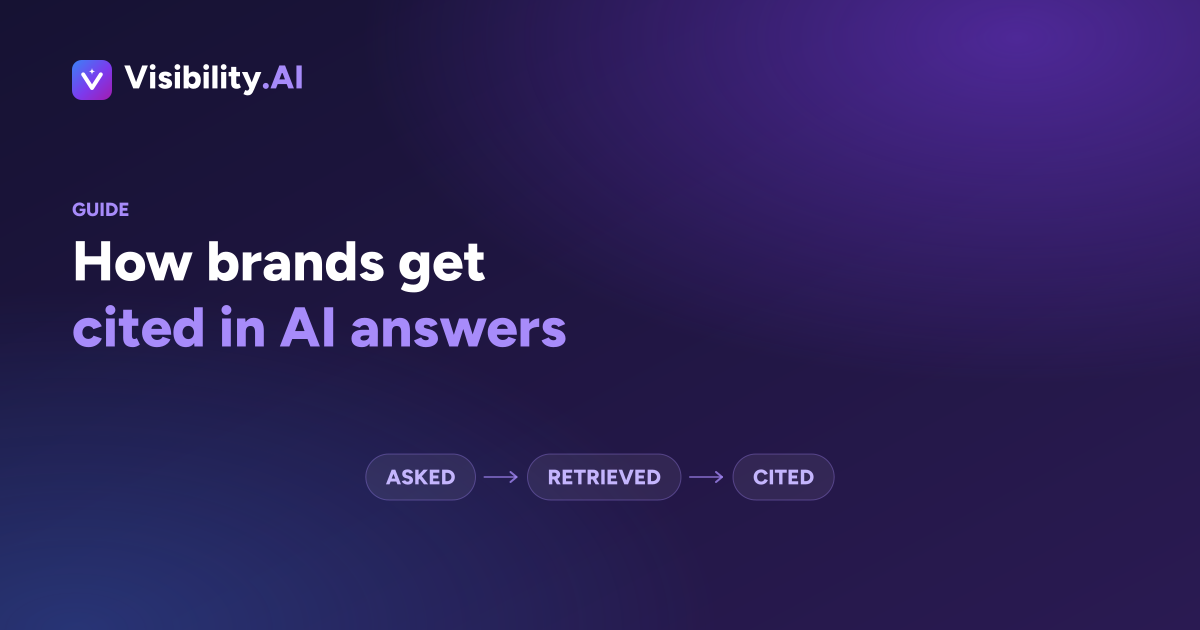
Most AI search surfaces don’t answer purely from memory - they retrieve. Understanding the pipeline tells you where to intervene.
- Retrieval (RAG). When you ask a question, the engine runs its own search against a live web index, pulls back candidate pages, and grounds its answer in them. This is retrieval-augmented generation: the answer is only as good as what retrieval surfaces, and it only cites the brands that show up in those results.
- Web index freshness. Surfaces like Perplexity and ChatGPT search lean on current web results, so recency and crawlability matter. A page that isn’t indexed or reachable can’t be cited.
- Trusted domains and corroboration. Engines weight sources that feel independent and consensus-backed - review sites, directories, reputable guides, community threads. A single self-promotional page rarely wins; multiple independent mentions do.
- Extractability. Clean, well-structured content that directly answers the question is easier for the model to lift and cite than dense marketing copy.
The practical implication: to get cited, you need to be (1) retrievable - indexed, crawlable, current - and (2) corroborated - present in the independent sources the engine trusts. Miss either and you’re invisible: an authoritative page the engine can’t retrieve is as absent as a retrievable page nobody else vouches for. AI search visibility lives at the intersection of both, which is why auditing per engine matters - each surface retrieves from a slightly different index and weights sources differently.
How to audit your AI search visibility per engine
Coverage varies dramatically between surfaces, so a blended score hides the truth. Audit each engine on its own terms.
- List the search-intent prompts that matter. Write the actual questions buyers ask when they’re looking - full questions with intent, location and qualifiers, not bare keywords.
- Run each prompt across every surface. ChatGPT, Perplexity, Gemini, Google AI Overviews, Google AI Mode, Copilot and Claude. For each, record: are you mentioned, cited as a source, or absent?
- Capture the sources behind each answer. Note which domains, review sites and threads the engine cited. This is your ground truth for where recommendations come from.
- Cross-reference competitors. Mark where rivals appear and you don’t. Those are your clearest, highest-value gaps.
- Score per engine. You may be strong in Perplexity and invisible in AI Overviews. Naming that gap per surface is the whole point of the audit.
Doing this by hand across seven engines and dozens of prompts is punishing to repeat weekly. Visibility AI’s Monitor runs the scans across all seven engines automatically, and Diagnose surfaces the exact sources and citations behind each answer - so the audit becomes a live dashboard instead of a spreadsheet.
A step-by-step framework to improve AI search visibility
Once the audit shows where you’re absent, improvement follows a repeatable order.
- Prioritize by intent, then gap size. Start with the search prompts that carry the most buying intent and where you’re missing. Don’t spread effort evenly.
- Fix retrievability first. Make sure the pages you want cited are indexed, crawlable, fast and current. A page the engine can’t retrieve can never be cited - this is the cheapest win.
- Earn corroboration in trusted sources. Get listed and reviewed on the directories and review sites the engines actually cite in your category. Show up authentically in the community threads they pull from. Pursue placement in independent “best X” guides.
- Publish extractable answer content. Write clear, structured pages that directly answer the search prompts - comparison pages, buyer’s guides, FAQs - giving the model something safe and easy to quote.
- Turn gaps into action. Convert each diagnosed gap into a specific task. Visibility AI’s Optimize module produces prioritized AI recommendations for exactly this, and its Content Agent drafts the citable content those gaps call for.
Measuring and tracking over time
AI search visibility isn’t static. Models update, indexes refresh, competitors publish, and answers shift week to week. A one-time audit goes stale fast, so treat visibility as a trend you watch:
- Track share of voice - your slice of brand mentions versus competitors - per engine, over time.
- Watch prompt coverage climb as your fixes land.
- Monitor citations to confirm your content is becoming a source the engines pull from.
- Report on movement. Visibility AI’s Performance module produces trends and reports that show whether your AI search visibility is genuinely improving, so the work is provable rather than anecdotal.
Local and B2B angles
Local businesses live and die on geo-qualified prompts - “best injury lawyer in Austin,” “emergency plumber near me.” AI search surfaces lean heavily on review sites, directories and map data for these, so presence and genuine recent reviews on the cited sources are the fastest lever. Auditing your local prompts per engine often reveals you’re winning in one surface and missing in another.
B2B brands face longer, more comparative prompts - “best CRM for a small law firm,” “alternatives to [competitor] for compliance teams.” Here, independent comparison content, analyst-style guides and authentic community discussion (Reddit, niche forums) carry disproportionate weight. Corroboration across several trusted third-party sources is what tips a B2B recommendation your way, because buyers researching a considered purchase ask follow-up questions - and each follow-up is another chance to be cited or to disappear. Tracking AI search visibility across that full prompt chain, not just the opening query, is where B2B teams find their biggest gaps.
FAQ
What is AI search visibility? AI search visibility is whether your brand shows up, gets cited and gets recommended across AI search surfaces - ChatGPT search, Perplexity, Google AI Overviews, Google AI Mode, Gemini and assistants like Copilot and Claude - when people search with intent. It’s your presence in the answer that has replaced the traditional results page.
How do AI search engines decide which sources to cite? Most retrieve live web results (retrieval-augmented generation), then ground and cite their answer in what they find. They favor retrievable pages - indexed, crawlable and current - and corroborated sources like review sites, directories, reputable guides and community threads. Clean, extractable content is easier for them to quote.
How is AI search visibility different from AI visibility overall? AI visibility is the broad measure of whether AI engines mention and recommend you across any context. AI search visibility narrows that to the search moment - the AI surfaces people use instead of a SERP. The metrics overlap (share of voice, citations, coverage), but AI search visibility is audited surface by surface.
How do I improve my AI search visibility? Prioritize high-intent prompts where you’re absent, fix retrievability so your pages can be indexed and cited, earn corroboration in the trusted sources each engine pulls from, and publish clear answer-style content. Then track share of voice, coverage and citations per engine over time to confirm you’re gaining ground.
AI search visibility is winner-take-most, and most brands can’t see which searches they’re already losing. If you want a per-engine audit and a prioritized path to get cited, Visibility AI’s free trial maps your AI search visibility across all seven engines - no credit card to start.