On this page
How are you tracking AI visibility? For a lot of teams, the honest answer is we’re not - or we opened ChatGPT once, typed our category question, and hoped the answer held. But when buyers ask ChatGPT, Perplexity or Google’s AI for the best option in your space, the answer they get back is the new front door to your business. If you’re not measuring whether that answer names you, you’re flying blind on the channel that increasingly decides the deal.
The good news: tracking AI visibility is very doable once you know what to measure. Here’s the framework.
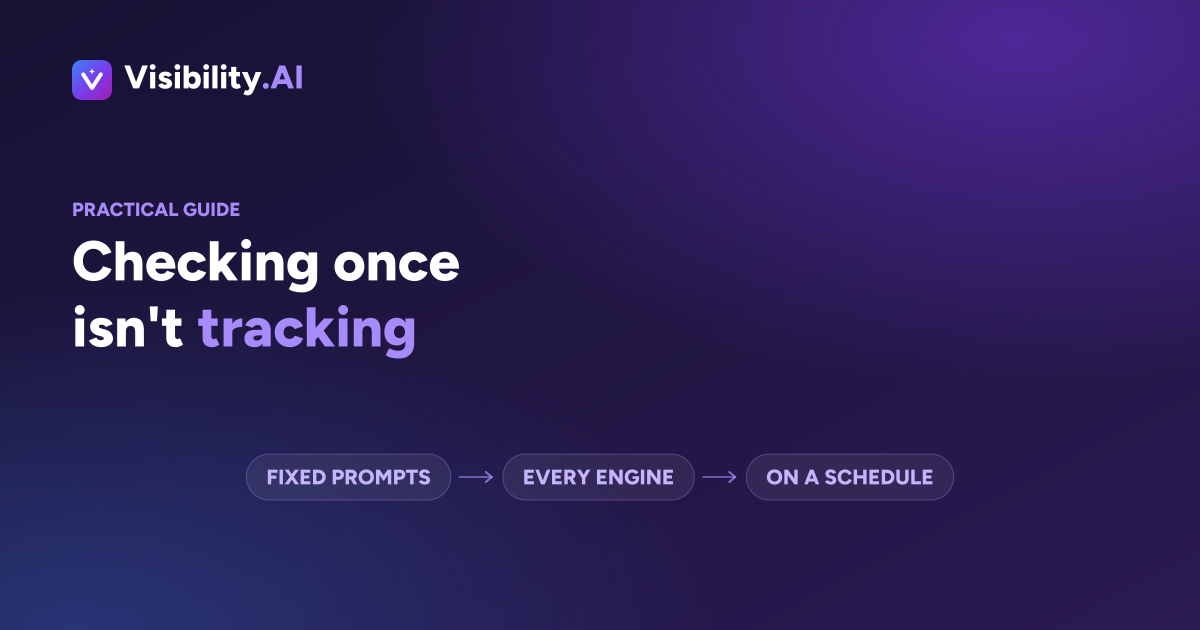
Checking once isn’t tracking
Opening an assistant and typing your question is a check, not a system. (A check is still worth running - see what a free AI visibility checker can tell you - it just isn’t tracking.) The model’s answer changes with every update, differs on every engine, and shifts as competitors publish new content. A single screenshot tells you how one model felt on one day.
Tracking means watching the same questions, across the same engines, over time - so you can tell a real trend from random noise. That distinction is the whole game.
The four things worth tracking
Good AI-visibility tracking comes down to four inputs. Get these right and your number means something; skip one and it doesn’t.
The prompts that matter
Track the questions your buyers actually ask an assistant, phrased as full questions - not keywords. A stable, high-intent prompt set is the foundation of everything else, because it’s what your score is measured against. If your list keeps changing, this week’s number can’t be compared to last week’s. (More on choosing prompts worth tracking.)
Every engine, not one
ChatGPT, Perplexity, Gemini, Google AI Overviews, Google AI Mode, Copilot and Claude all answer the same question differently and pull from different sources. Measuring one engine gives you a fraction of the picture - and you can lead on one while quietly disappearing from another.
Share of voice
Presence alone isn’t enough. What you want is share of voice: of all the answers where your category comes up, how often is it you the AI names - versus your competitors? That single figure turns a vague worry (“are we invisible to AI?”) into a position you can defend and improve.
The trend over time
One snapshot is a data point; a line is a signal. Because AI answers move for real reasons - model refreshes, competitor content, changes to your own pages - tracking the same set on a schedule is what tells you whether you’re winning or slipping, and where to look when something shifts.
How often should you track it?
For most brands, weekly is plenty to catch meaningful movement without chasing noise. High-velocity categories, or periods when you’re actively publishing and optimizing, justify a tighter cadence. The rule that matters isn’t the frequency - it’s the consistency: same prompts, same engines, regular schedule, so every run is directly comparable to the last.
Where DIY tracking breaks
Most teams start with a spreadsheet: a tab of questions, a column per engine, a manual pass every few weeks. It works - until it doesn’t. The prompts drift, someone forgets a run, the engines add new surfaces, and comparing this month to last becomes guesswork.
Manual tracking also struggles to capture the two things that actually explain your score: who else got named in the answer, and which sources the engine cited to build it. Without those, you have a number but no reason behind it - and no clear next step.
What good tracking looks like
The version that sticks is automatic and comparable: a fixed prompt set scanned across every engine on a schedule, rolled into one share-of-voice figure per engine and overall, with competitor context and cited sources attached, and history kept so you can read the direction - not just the day.
That’s exactly what an AI visibility tracker is for, and what AI Monitoring in Visibility AI does. It runs your prompts across all seven engines, records mentions, citations and share of voice, flags who’s named instead of you, and keeps the trend so a drop shows up as a line on a chart rather than a nasty surprise.
Start with a baseline
You can’t improve a number you’ve never measured. The fastest way to answer “how are we tracking AI visibility?” is to set a real baseline: pick your prompts, run them across every engine, and write down exactly where you stand. From there, tracking becomes a habit - and the gaps you find become a short, high-value to-do list.
If the baseline comes back lower than you expected, tracking alone won’t tell you why. That’s a diagnostic job, and our AI visibility audit framework works backwards from the answers to the sources, entity data and site issues behind them.
Visibility AI’s free trial sets your baseline across all seven engines in a few minutes, no credit card required - so the next time someone asks how you’re tracking AI visibility, you’ll have a real answer, and a real number.